Is the Human Brain just a fleshy computer, or does it house something more complex, something that can not be replicated?
If I Only Had a Brain (copy)
Reply
Is the Human Brain just a fleshy computer, or does it house something more complex, something that can not be replicated?
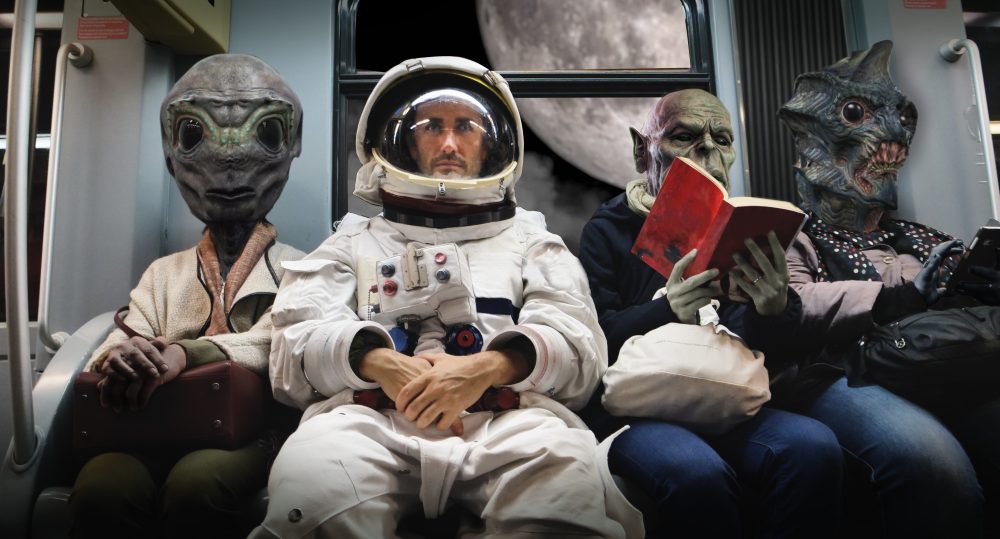
Is it possible for an alien to give you the bird? The classic alien in Science Fiction (or around some trailer parks, Science Fact) has a big head, big eyes, skinny body and hands. Although having some distinguishing features that set them aside, they are certainly humanoid with a tubular body, arms, legs and a head. But what are the odds that intelligent life, at least capable of traveling the stars, communicating across long distances, and playing music in the Mos Eisley Cantina, would evolve with a Humanoid body plan? Does Science Fiction have it right, or is it just easier to put makeup and prosthetics on human actors?
Frankenstein; or The Modern Prometheus is one of the earliest examples of Science Fiction. Mary Shelley began the novel when she was only 19 years old, and it was first published (anonymously) when she was 21, in 1818. The idea came to Mary in the form of a dream after her, her husband Percy Shelley, Lord Byron and John Poidori decided to have a competition to see who could write the best horror story. The novel takes place in Geneva, an area Mary had travelled through where occult ideas such as galvanism (the contraction of a muscle that is stimulated by an electric current) had become favorite topics of conversation. The novel tells the story of Doctor Victor Frankenstein, who has become obsessed with theories of science that focus on achieving natural wonders. He witnesses an oak tree split in half by lightning and is inspired to capture its power while developing secret techniques to infuse life back into inanimate bodies. Victor is forced to construct a larger creature because he finds it difficult to replicate small parts of the human anatomy. His creature therefore becomes hideous compared to the ideal beauty he was striving for. After bringing the creature to life, Victor is repulsed by what he has done and flees the laboratory leaving the creature behind, abandoned and hopelessly sad and full of Daddy issues. The two lives, Victor’s and the creature’s, are now intertwined until they are ultimately their own undoing, dragging everyone connected to them into the horror, including Victor’s fiancé Elizabeth. Since the novel’s publication it has spawned incredible popularity and a whole new genre of horror, not to mention its contribution to Science Fiction.
The study of Quantum Physics started in 1900 when physicist Max Planck first introduced the concept to the scientific world. The results of his studies in radiation simply contradicted the classical physical laws, suggesting that there are other laws at work in the universe. Other physicists studying this new concept also noticed photons, tiny packets of light, acting as particles and as waves with single photons exhibiting shape shifting behavior. Imagine going out to your car in the morning and your vehicle taking a gaseous form rather than the solid object you locked last night? It would be just that odd. This has become known as the Heisenberg Uncertainty Principle when physicist Werner Heisenberg suggested that just by observing quantum matter we affect the behavior of that matter, asserting that there is a fundamental limit to the precision with which certain pairs of physical properties or complementary variables can be known simultaneously. This idea is later supported by the Copenhagen Interpretation of Quantum Mechanics posed by physicist Niels Bohr. His interpretation states that all quantum particles don’t exist in one state or the other, but in all of its possible states at once. The sum total of all possible states of a quantum object is called the objects Wave Function, and the state of an object existing in all of its possible states at once is called Superposition. Observation breaks an object’s Superposition and forces it to choose one state from its Wave Function. This accounts for why physicists have taken opposite measurements from the same quantum object, as the object can choose different states during different measurements.
 Sci Fi Smackdown